SIMSREE FINANCE FORUM

Wednesday, July 19, 2017

Introduction to RERA: Part (1/3)

Introduction to RERA
The real estate sector has grown in the recent years but has largely been unregulated mainly from customers perspective. The provisions and law which were available were not much of preventive. It had affected the potential growth of the sector.
The Real Estate (Regulation and Development) Act, 2016 (RERA) became effective from May 1, 2017 and has been established for regulations and promotion of the real estate sector and to ensure functioning in efficient and transparent manner. According to RERA, each state and union territory will have its own regulator and set of rules to govern the functioning. The objective is to protect consumer interest in the real estate sector and to establish a proper mechanism for speedy dispute redressal. RERA seeks to bring clarity and fair practice from builders that would protect the consumer and impose penalties on errant builders.
Delays in projects, price, quality of construction and other changes are some of the major issues faced by the consumers. RERA seeks to address these issues. Some of the important rules set up in RERA are:
  1. Booking amount: RERA brings in the constraint on the booking amount the builder can ask for at the time of registration to 10% of the cost of the property. It cannot accept more than 10% as an advance payment without first entering into a registered agreement for sale.
  2. Flow of funds: The main reason for delays in projects or poor quality of construction include diversion of funds to other projects. Builders would use funds on a project received from various other projects, leaving some of the them under construction for decades. Under RERA the promoter of a real estate development firm has to maintain a separate escrow account for each of their projects. A minimum of 70 percent of the money from investors and buyers will have to be deposited in that account which could be used for that project.
  3. Registration of projects: RERA brings in various provisions for registration of projects which ensures safety of consumer interest.
  4. Carpet area has been clearly defined in the bill imparting clarity which was not the case earlier.
  5. Online information: To enable informed decision by buyers, Real Estate Regulatory Authorities will ensure publication on their websites information relating to litigations, advertisements and prospectus issued about the project, details of apartments, financial details, status of approvals, etc.
  6. Interest on default: The state RA has to specify the rate of interest on a default. Payment of which has to be made within 45 days of it becoming due.


Conclusion: Bad construction quality, delayed delivery of projects, etc. were some of the common problems faced in the industry. Till now there was no regulatory authority with set rules and regulations, the homebuyers were at the mercy of the builders. RERA is a huge step forward to frame the rules and regulations with respect to the interest of the buyers and not dilute them in builders favour.

Buyers will look forward to promoters falling in line and sharing all information as required by the authority, transparency by making the information available online and a robust feedback mechanism between the authority, promoter and buyer.

Friday, July 14, 2017

Technical Analysis: An Introduction

Have you ever been confused on how to start with a technical analysis of a stock, index, commodities, Currency etc.? This article aims at solving the puzzle.
First of all, Technical analysis isn’t the only way, there are fundamentalists too. But fundamental analysis tends to lag because, Fundamentalist studies the cause of the market movement, and Technician studies the effect.
Let’s define Technical Analysis: The study of market action, primarily through the use of charts, for the purpose of forecasting future price trends is Technical Analysis.
Market Action includes: Price, volume and open interest
There are three assumptions on which the Technical Analysis is based:
  • Market action discounts everything
  • Prices move in trends
  • History repeats itself
Myth: Fundamental analysis is good for longer horizon (long term trading aka BUY and HOLD) while technical analysis is superior on the shorter terms (positional trading), but this isn’t the case.
Myth-buster: Technical analysis is a great tool for all time horizons. Let it be a 3 minute move or a 30 year chart. The same don’t apply to fundamentals. Fundamentals factor the financial performance of the company to arrive at the intrinsic value, and if that value is more than the Current Market Price, the market is undervalued and should be bought and vice versa. Fundamentals don’t change on 3 minute basis. They change only when the latest quarterly numbers change the valuation of a company, or if there is any corporate announcement.

Some criticisms of The Technical Approach:
  1. Self-Fulfilling Prophecy: They say, chart patterns are already known to traders since 30+ years now, and they can now trade according to the bullish or bearish indicators, which creates a “self-fulfilling prophecy” as the waves of selling or buying are generated in response to bearish or bullish indicators.
The counter argument:  Chart patterns are completely subjective. A buying for Mohan can be the point where Sohan is selling his stocks which he held for many years. No study has mathematically quantified proved the complete charting. Because it is literally in the mind of the beholder
  1. Can the past tell us about the future?: Statistics is sub divided in 2 types
  • Descriptive: referring to graphical representation of data i.e. price data on bar, candlesticks.
  • Inductive:  Generalisation, predictions or extrapolations which are inferred from the data.
The Price chart itself comes under the Descriptive side, but the so-called analysts who take the trades and represent the market participants are from the Inductive side. Hence, even though is seems less likely that the chart repeats themselves, but Market is a group of people  trading, and where there are humans, the behaviours repeat in a similar fashion for a similar event. Hence the market crashes are always ruthless, and huge.

Dow the original WOW!
Most technicians who follow the trends and patterns today are in one or the other way the derivative of the theory first proposed by Dow.
Basic Tenets of Dow Theory:
  • The average discounts everything
  • The markets has three trends: Primary, Secondary and Minor
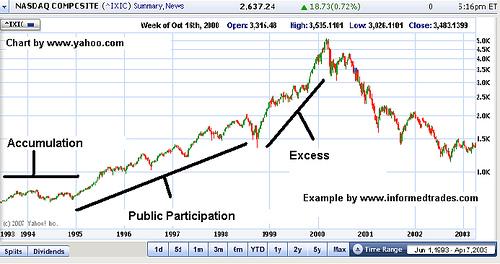
  • Each Trend has three phases: Accumulation, Public Participation, Distribution phase
  • The Averages Must Confirm each other
  • Volume must confirm the trend
  • The trend is assumed to be continued until it gives definite signals that it has reversed.
Criticisms of Dow Theory:
On average, Dow Theory misses 20 to 25% of the move before generating the signal. Many of them consider this as “Late”.
But Traders should remember that Dow never intended to anticipate trends, but was interested to find Bull/Bear trends and to capture the large middle portion of important market moves.


…to be continued.

Wednesday, November 16, 2016

Basics of Derivatives

Derivatives: A derivative is a financial instrument whose value as the name says is DERIVED from the value of an underlying asset. The asset could be anything for e.g. commodities, stocks, Forex etc.
The major derivative products are:


Forwards: 
A forwards contract is an agreement to buy/sell at a specific price on a specific date. Now the question is why is it done? The reason is to safeguard from the fluctuation of prices in the future. Let us take the example of a cranberry juice manufacturer and a cranberry supplier. 
For the juice manufacturer cranberry is a quintessential raw product. 
Suppose the price is 30/Kg.
If the price after 2 months is 36/Kg, it would take a hit on the manufacturers profit by 20%. On the other hand if the price of cranberry becomes 27/Kg it increases the profit by 10% in simplistic terms.
So, the manufacturer here is exposed to what is known as market risk or in simple terms the fluctuation of prices in the commodity of interest. 

Therefore, the manufacturer would like to enter into a forwards contract which would specify that he/she will buy 100 Kg of cranberry at 31/Kg after 3 months thus HEDGING itself against the market risk. 
But here the condition is that there should be someone to take a reverse position in the contract. That is, there should be  a cranberry supplier who will be ready to sell at 31/Kg after 3 months. 

The supplier is safeguarding/hedging against a decline in prices whereas the buyer is hedging against a rise in prices.
The supplier profits if the price if the cranberry market price is below 31/Kg and the buyer makes a profit if the market price is greater that 31/Kg. 


Futures:
A Forwards contract could be agreed between anyone at whatever price, date, location and other details that they seem fit. Only condition is that both the parties should agree to the contract. 
However, A futures contract is more standardized in terms of the contents of the contract which are the the price, quantity, delivery date of the product etc.

Lets take an example of ABC Ltd.
Current price of ABC Ltd is 100.
The buyer of the futures contract would be ready to buy ABC Ltd. shares at 105 after 3 months. For this there should be a seller who is willing to sell ABC Ltd. at 105 after 3 months. 
Here the price 105 and suppose the quantity was 250 shares. These figures are decided/regulated by the exchange.
The futures contracts are traded over the exchange. 

Risk in forwards and futures: Forwards contract have a inbuilt risk of either party defaulting as it is not regulated. For example, the supplier may deliver the cranberries but the manufacturer may refuse to pay the money or vice versa i.e the supplier would refuse to sell after 3 months at 31/Kg. 
However, counter party risk is eliminated in futures as the contracts are well regulated.


Options:
There are two parties involved in option trading namely the buyer of the option and seller of the option. These have to be differentiated from the seller and buyer of the asset.
The seller of the option is also called as the writer of the option.

Options are of two types: 

Call Option: The buyer of the call option agrees to buy the asset at a specified price in a particular time period. As usual, there has to be seller/writer for this option who takes the reverse position.
Put Option: The buyer of the put option agrees to sell the asset at a specified price in a particular time period. As usual, there has to be seller/writer for this option. In this case the seller refers to the seller of the option though his position would be buying the asset.

There are 4 terminologies associated with options:
Strike price: The price of buying/selling the asset.
Spot price: The current market price.
Premium: An amount paid to the seller of the option (Explained later).
Expiry period: The period for which the contract can be executed.

CALL OPTION: 

Suppose the current price of ABC is 400.The buyer now thinks that after one month the price of ABC would be higher than 420. So he enters into a contract to buy ABC at 400 withing an expiry period of one month. Let's say the premium is 4. So he has to pay 4 per 100 shares to the seller/writer of the call option.

Case 1: Now lets say at the end of the month, the spot price/market price is 390 which is less than 400. So now if the buyer buys at 400 plus 4 premium per 100 shares, he will suffer loss as in the market its available at 390. So the buyer can exit the contract and needs to just pay the premium to the seller/writer. 
That's why the name OPTION. The buyer has the option but not the obligation to exercise the contract. He can anytime exit the contract by just paying the premium thus minimizing his losses only to the amount of the premium. In this case the seller profited by earning the premium. 

Case 2: Let us the assume now that the spot price is 430. The per share profit is 30 as the strike price/buying price is 400. In this case the buyer will exercise the option and receive the assets at 400 plus the premium. 
It is important to note that the seller of the option has the obligation. If the buyer exercises his option, the seller has fulfill his/her end of the contract.

In short if the strike price is greater than spot price, don't exercise the option. 

PUT OPTION: 

Suppose the current price of ABC is 400. Remember, the BUYER of the put option agrees to SELL the asset at a specified price. Always remember he is referred to as the buyer because he is buying the option though he is selling the asset.
The buyer of the put option believes that within this month the market price of ABC will go below 380 and thus wants to sell at 400 within this month. Consequently, there will be a SELLER/WRITER of the put option who will be ready to BUY at 400.

Case 1: Now lets say at the end of the month, the spot price/market price is 390 which is less than 400. So if the buyer decides to execute the put he would have a profit of 10 per share minus the premium as the market price is 390 and he is selling at 400. Thus he will exercise the option and seller of the put has to buy at 400.

Case 2: Let us the assume now that the spot price is 430. In this case the buyer of the option will make a loss as the market price is 430 and he would be selling at 400- the strike price. So the buyer will decide not to execute the option and will exit the contract by paying the premium to the seller of the option. Whatever happens the seller of the option always gets the premium and the buyer of the option always has the right but not the obligation.

If the spot price is greater than strike price, don't exercise the option.


We will cover swaps in a separate article.

If any improvements/suggestions shoot them in the comments below. 
Happy reading :)


Tuesday, September 15, 2015

BETTING BIG ON ECOMMERCE: DELUSION OR REALITY?

It is quite normal these days to be bombarded frequently, with news related to the ecommerce industry which is considered to be a sunrise industry from an Indian context. Exciting news articles quoting astronomical valuations of ecommerce companies have almost become a norm. While it is very affirming and pleasant to paint a rosy picture of the ecommerce industry in India, it needs to be done through a lens of rationality. This brings us to the basic concept of Gross Merchandise Volume or GMV which is a key parameter used to measure the state of an ecommerce company. GMV is a measure of the value of goods sold on a site, without accounting for discounts or sales returns. The valuation of a company is then arrived at by doubling or tripling this GMV. As such, given the valuation of a company, we can imagine the actual revenue by working backwards. Another major problem is that the ecommerce players are on a customer acquisition spree, fuelled mainly by large discounts which are in turn financed by leading global investors. This is certainly fine for an initial stage but unsustainable in the long run. The basic premise, on which the aggressive funding by investors rests on, is that after a certain degree of comfort with regard to the online channel, customers will prefer it over the traditional channel, even in the absence of discounts. While there is no denying that this is very much possible given the fast and hectic pace of lives that we today lead, the problem lies in identifying those select few companies from an apparent smorgasbord of companies that will survive the test of time to be able to give those windfall returns to its present investors.

Another factor that will be vital in deciding the future of ecommerce in India is the growth of the data services in India. With the major telecom players preparing to engage in a serious battle to gain customers by offering reliable 4G data services, the stage does seem to be set for the ecommerce industry to thrive and effectively tap the retail industry with relative ease.
Besides the technological aspect, another vital factor that will define the position of ecommerce in India is the legal perspective. Currently foreign direct investment is not allowed in the online retail sector in India. To overcome this hurdle, the Indian ecommerce companies operate on an online marketplace model that serves to simply provide a platform for buyers and sellers. The brick-and-mortar retailers have a representative body called the Retailers’ Association of India or RAI which moved the Delhi high court in May seeking parity between online and offline retailers. Consultations are going on amongst brick-and-mortar retailers, online retailers, and policy makers to decide upon the laws in this regard. If the rules allow foreign investment in both online and offline segments, the online landscape is likely to become more complex, since existing offline retailers having a strong presence in the retail segment might decide to jump into the online bandwagon. This can be aptly illustrated through the example of a company like Aditya Birla Nuvo Ltd. (ABNL) which already has a strong presence in the offline Fashion and Lifestyle segment. If it enters through the online channel, it can build upon its existing brand equity to attract customers and also leverage the benefit of having a payment bank whose licence it recently received from the RBI. Thus an integrated business model having online, offline, and payment infrastructure capabilities can effectively compete against the existing only online players.

Advertising revenue is another option which the Indian ecommerce players have been trying to avail in order to move towards being a profit making entity and also to achieve better targeting of customers. This was amply demonstrated by Flipkart’s acquisition of AdIQuity Technologies, a mobile based advertising technology firm in March to improve the former’s ad platform and more recently, Snapdeal’s acquisition of Reduce Data, a US-based advertising platform which helps brands to deliver advertising strategies for consumers across platforms and devices.
All said and done, the fact remains that predicting the future of ecommerce in India is a difficult task. This is simply because the future does not depend on only one or two factors. It will rather turn out to be a result of a complex interplay between various parameters that are mutually affected by each other. All that should be hoped for is that the Indian consumer gains along with the other stakeholders involved in and affected by this industry.

- Siddharth Shah

SIMSREE Finance Forum

Tuesday, September 1, 2015

Perfect Time for Oil Pricing Reforms

Oil prices across the world have been falling over past year. They have headed towards south by more than 50 percent. This phenomenon has caused a lot of hesitation across the globe. The economic effects have been beneficial for oil importing countries and detrimental for oil exporting countries. The major oil exporters are Middle Eastern countries, Russia, Iran and Norway and major oil consumers are USA, China, Germany, Japan, etc.  As a result, a redistribution of resources (oil products) is taking place between winners (oil consumers) and losers (oil exporters).  As oil prices are falling, losers are losing a lot of revenue, which, in turn, is reflecting in their balance sheet as petroleum exports is their major income source. On the other hand, winners are enjoying monetary benefits as their imports are decreasing and fiscal deficits are becoming manageable. So, the dilemma is to find a panacea such that both winners and losers should be comfortable with the prices. In other words, we should decide whether to try to push prices up to discourage oil consumption or to try to push further down to capitalize monetary gains which will also discourage oil production.

To arrive at a solution to this, oil economics should be understood first. Most of the emerging markets have subsidized oil business to keep oil prices below market levels. A recent study by International Monetary Fund (IMF) estimated that global energy subsidies are running at more than $5 trillion per year. These subsidies are disposed as a way to improve income distribution. But the reality is nearly the opposite. Poor people are not the ones who usually prefer driving and use public transport. Less than 20% of the subsidy payments benefit the bottom 20% percentile amongst the society. Last year, Egypt, Ghana, India, Indonesia, Malaysia, Mexico, Morocco, and the United Arab Emirates have all reduced or abolished subsidies forever. Oil prices, in these countries, are kept floating according to international market rates. As a result, oil consumption is being curbed owing to net increase in oil prices post subsidy removal. Due to large dependence on fossil fuels, an increase in oil prices would directly impact domestic transportation and industrial production.

There is another solution to the dilemma which would cost environmental externalities and national economic security. If oil prices are kept low, it will be consumed at a faster pace. The net impact on consumption is clearly positive for global growth, but the downward price shift will discourage investment in energy production, which will trim overall economic demand. High oil consumption leaves a country (non oil producing) vulnerable to external fluctuations. A good example is political instability in Middle-East affecting global oil prices. Historically, prices have been escalating in the wake of such crises.

At the same time, higher oil consumption would worsen the problem of traffic congestion, accidents and air pollution. So, leaving aside direct economic effects, environmental and other externalities are affected the most.

In a nutshell, the situation demands a tradeoff between environmental concerns and industrial growth. The solution to this problem is that countries should impose both: lower the prices paid to producers and raise the prices paid by consumers, by cutting subsidies and imposing taxes. This will accomplish two objectives- money saved from subsidies and raised from imposed taxes could be used to fund desirable spending and lowered oil consumption would enable us to combat environmental plights and other external disruptions. At the end of the day, the future of oil pricing totally depends on the policies that both consumers and producers make.

-  Vijay Saraf

SIMSREE Finance Forum                                                              

Friday, July 3, 2015

An Analysis of Reliance Jio 4G Launch

Mr. Mukesh Ambani, Chairman and Managing Director, Reliance Industries Ltd. unveiled plans for its 4th Generation (4G) services at the Company’s 41st AGM here on 12th June, 2015. Mr. Ambani revealed that commercial operations for Jio will start by December, 2015. High speed data will allow for instant messaging, live TV, movies on demand, news, streaming music on the go. Reliance Jio Infocomm which has taken over 5 years to materialize and has gobbled up over US$ 13 billion (₹80,000 crore) in infrastructure investments is one of the most-awaited launch and is expected to leapfrog Indian telecom sector by 10-15 years. 

A Price-war is sure to ensue in the world’s 2nd largest mobile services market after China, where Reliance Jio will take on incumbents like Airtel and Vodafone for market share. Rational pricing would be very critical for Jio in order to gain market share in a highly price-sensitive market. A similar strategy was adopted by the late Mr. Dhirubhai Ambani some 15 years ago when he disrupted the telecom market by making call rates as cheap as post cards. From what has been mentioned, Mr. Mukesh Ambani is also expected to adopt a similar strategy as Jio would offer 4G services at half the price of similar existing data packs (₹300-500 against the existing prices of ₹1000 for data packs). Low pricing strategy would help build awareness and also increase the overall internet penetration in urban and rural areas of India. This also blends well with the Prime Minister’s Digital India theme to bring most services online.

However, Reliance Jio is expected to be a pure play data services at the outset.  There is a conspicuous absence of any voice-based strategy in the Jio launch announcements.  Voice contributes to close to 85% of the industry’s revenues(4 billion voice minutes per day) and it would be interesting to see if Reliance JIo’s data-dominant offerings appeal to the mass market. According to KPMG, pure-play data services may not attract the requisite customer base as the current urban telecom penetration is over 100% and rural penetration over 50%. According to BofA-ML, dual SIM smart-phones could be attract potential customers – one SIM for voice calls other for Jio’s high speed data offerings. Reliance Jio will have to bring much more to the table than just 4G at affordable rates to lure away customers from the incumbent carriers.

Apart from the data-only worries, Rel-Jio may also have to enter into spectrum trading or sharing agreements with telecos to overcome gaps in its pan-India network (Rel-Jio holds license in 14 of 22 circles in the 1800 MHz spectrum and Pan-India spectrum in 2300MHz spectrum). Also, with investments over ₹80,000 crore in this space and 100% pan-India coverage expected only after 3 years, (80% coverage by Dec. 2015) it would be interesting to see when Reliance Jio Infocomm turns profitable.

          -    Rohin Jacob
       SIMSREE Finance Forum

Friday, May 15, 2015

Analysis of Iraq’s Crude Oil Export Infrastructure


Iraq holds around 144 billion barrels of proved crude oil reserves and has been the second largest crude oil producer in OPEC in the recent past. Moreover, according to industry analysts the country intends to increase its crude oil production from the current level of around 3.5 million barrels per day to close to 9 million barrels per day by 2020! To that end, Iraq’s Ministry of Oil has signed contracts with various International Oil Companies to develop its hydrocarbon rich oilfields, especially West Qurnah, Zubair & Kirkuk.

However, while production capacity growth is expected to surpass all past records, I have my doubts about the export infrastructure of the country. Till 2007, the country’s infrastructure was in a horrible condition. The major export terminals of the south – Al Basrah & Khawr Al Amaya which were exporting about 95 % of the 1.6 million barrels per day, were serviced by age old corroded pipelines. In 2007, the Ministry of Oil realized the seriousness of the situation and conceptualized the ICOEEP to increase the southern export capacity by around 4.5 million barrels per day by 2013. The plan was to install 5 new off-shore structures called Single Point Mooring Systems (SPMs) to load crude oil onto tankers & export it via sea. Unfortunately, the country’s exports from the south averaged only around 2.47 million barrels per day in 2014. Another 0.13 million barrels per day were exported to Turkey via the pipelines of hell viz. pipelines in & around ISIS held territories in the North.

The off-shore SPMs aren’t the culprits here; three of them (900,000 bpd loading capacity each) are already operating and the fourth one is waiting to get oil from the Al FAO storage terminal on the shore. The problem lies with Iraq’s inadequate storage, pumping & pipeline capacity (midstream infrastructure). According to on field research conducted in Iraq, the country does not have more than seven days of storage capacity. The pipeline infrastructure is, in my opinion (on the basis of secondary research), another problem & so is inadequate pumping capacity, which prevents pipelines from being utilized at full capacity. Apparently, export capacity has expanded at a greater rate than the midstream infrastructure.

Iraq's state-owned South Oil (SOC) aims to boost export capacity to 3mn b/d by the end of next year. On the whole, while Iraq’s Oil ministry plans to increase the export infrastructure facilities significantly in the next five years, only ‘time’ (Kāla in Hindi) almighty can tell about whether or not it will attain success in its noble endeavors.

- Jeet Juneja
  SIMSREE Finance Forum